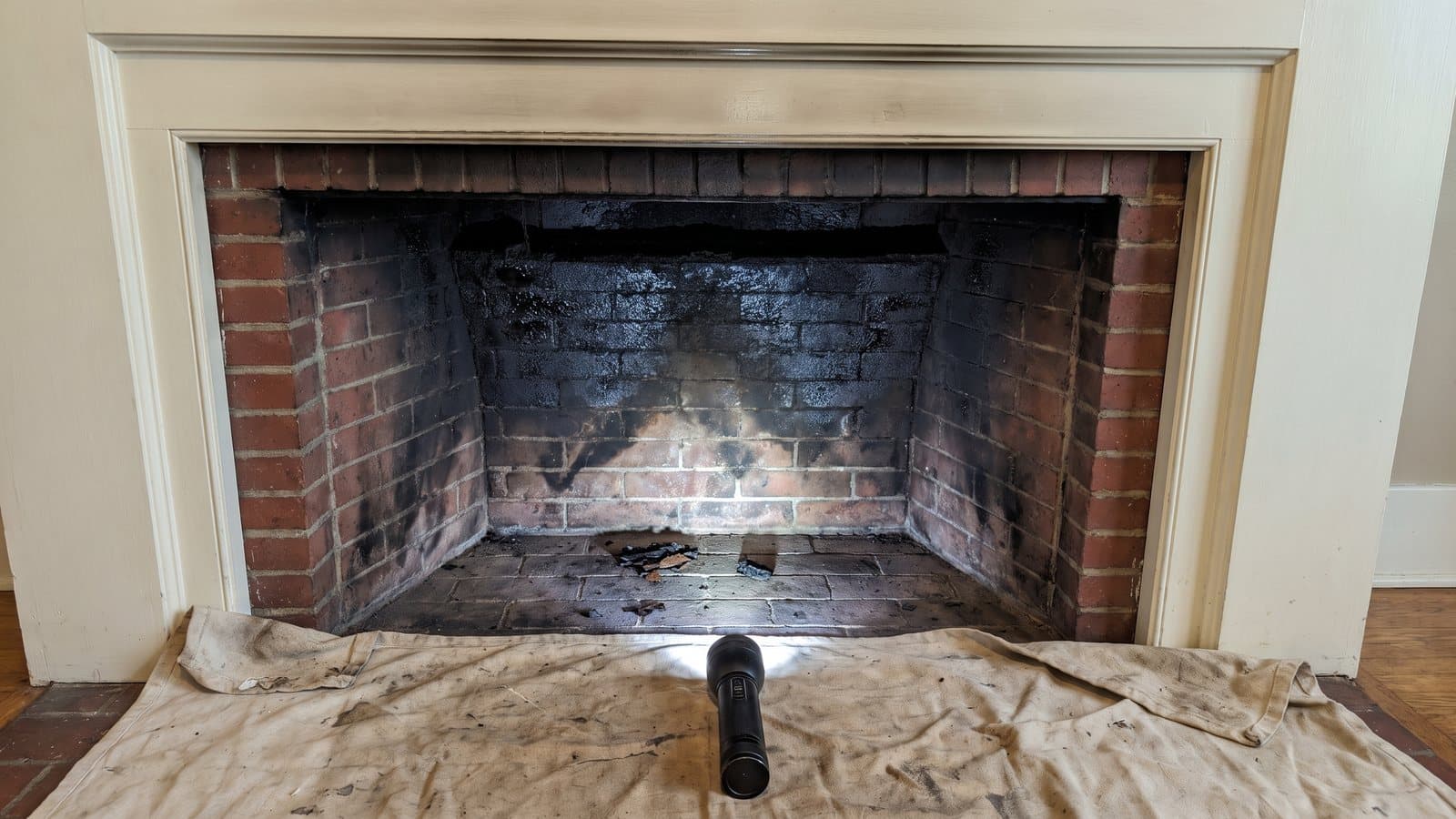
Wood smoke that cools before it clears the chimney leaves a residue on the flue wall, and that residue is creosote. It burns, and a flue coated with it can catch fire from the hearth below. The good news for North Seattle homeowners is that the rules already written here for clean air are, almost item for item, the habits that keep a flue clean. This guide explains how the deposit forms, the depth at which it should come out, the local burning rules that double as prevention, and what removal involves.
From wood smoke to a creosote crust
A wood fire gives off water vapor, gases and tiny droplets of unburned tar. All of it rises through the flue. Where the flue wall is cooler than the smoke, part of that mix condenses on it, much as breath fogs a cold window. Layer over layer, the film turns into a crust.
Three things speed the process: wood that is still wet, a fire starved of air until it smolders, and a flue that stays cold. Each one either lowers the temperature of the smoke or slows its way out.
How much creosote is too much
For a masonry fireplace, the threshold set by the Chimney Safety Institute of America is soot 1/8 inch thick, and sooner than that if any of the deposit is glazed. For a factory-built fireplace its guidance is stricter: sweep at any appreciable buildup.
Glaze is the form to worry about. CSIA explains that crusty creosote can be taken off by rotary cleaning, while the gummy or glazed kind has to be treated chemically, to change its makeup, before a brush will shift it. That is slower work and can take a second visit.
| What is in the flue | CSIA guidance | How we bill it |
|---|---|---|
| Loose soot, 1/8 inch deep | Time to sweep a masonry fireplace | Standard sweep |
| Any appreciable buildup, factory-built fireplace | Sweep now | Standard sweep |
| Crusty, flaky creosote | Comes off with rotary cleaning | Sweep or removal, by amount |
| Gummy or glazed creosote | Chemical treatment, then brushing | Creosote removal |
Seattle's burning rules, read as a creosote checklist
Burn only dry wood. Under Puget Sound Clean Air Agency rules and state rule WAC 173-433-120, a fireplace or stove may legally burn two things, seasoned firewood or manufactured logs. Plastics, garbage and treated wood are all illegal fuels. So is paper, apart from the little needed to get a fire going. Everything on the banned list also happens to foul a flue.
Watch the smoke. Outside of burn bans, a 20 percent opacity ceiling applies to whatever comes out of the chimney; the reading is taken through six straight minutes of any one hour. Dense smoke once a fire is established means wet wood or too little air, and both are creosote in the making. The agency also treats smoke that reaches a neighbor as a nuisance it can enforce against.
Respect the bans. For King County the agency calls a burn ban when its forecast shows fine particles climbing past 35 micrograms per cubic meter on a 24-hour average sometime during the next two days. Stage 1 means no fire in a wood fireplace, nor in any uncertified insert or stove. Stage 2 extends the shutdown to certified stoves, and pellet stoves with them. The single exception at either stage is a household with no other adequate heat that holds an exemption approved by the agency. Under WAC 173-433-150, anyone already burning must stop adding fuel, and smoke still visible three hours after the declaration counts as evidence of a violation. The agency's website shows whether a ban is on.
The agency's 2024 data summary gives the reason for all of it: wood smoke from home heating is the main winter source of fine-particle pollution in the region.
The occasional North Seattle fire, and the outage fire
Hardly anyone in North Seattle heats mainly with wood. The Census Bureau's 2020-2024 estimates put the wood share at 0.5 percent or less in every ZIP area here: about 130 households in 98103, about 40 in 98117, roughly 80 in 98125, and an estimate of zero in 98107 and 98115. Fireplaces are far more common than those numbers suggest, because the survey asks only about a home's primary fuel.
The usual local fire is therefore a short one, lit in a cold flue on a weekend evening. A short fire spends most of its life in a flue that has not warmed up, which is the very condition described above. Low use does not mean a clean chimney.
Power outages are the other case. In the 2006 windstorm, 49 percent of Seattle City Light customers lost power, and full restoration took a week. A fireplace that sits idle most winters can suddenly be burning all day. The city's windstorm profile also records that people have died in outages after lighting charcoal inside the house to keep warm. A chimney checked ahead of storm season is the safe way to have backup heat.
At the hearth: the State Fire Marshal's short list
The State Fire Marshal's heating notice of September 2026 covers the household side. Keep a three-foot zone around the fireplace clear of children. Use a screen or glass doors. Have a cap on the chimney. Keep smoke alarms and carbon monoxide alarms working. Let ashes cool completely, move them to a lidded metal container that closes tightly, and keep it outdoors at a distance from the house.
If you hear a roar in the flue or see sparks or flame at the chimney top, leave the house and call 911. Afterward, light no fire until the flue has been scanned from top to bottom.
Sweep or creosote removal: the figures
A standard sweep with us is $209 to $459, depending on the appliance and on roof access. Hardened or glazed deposits are billed as creosote removal, from $245 up to $585 for the heaviest glaze.
Published elsewhere: The Mad Hatter Chimney Sweep's Seattle guide lists heavy stage 2 to 3 creosote removal at $300 to $600, marked with a plus sign, and Housecall Pro's trade article gives $100 to $300 nationally as a surcharge on top of the base cleaning. Each was consulted on October 4, 2026, and neither is ours. Not our quote.
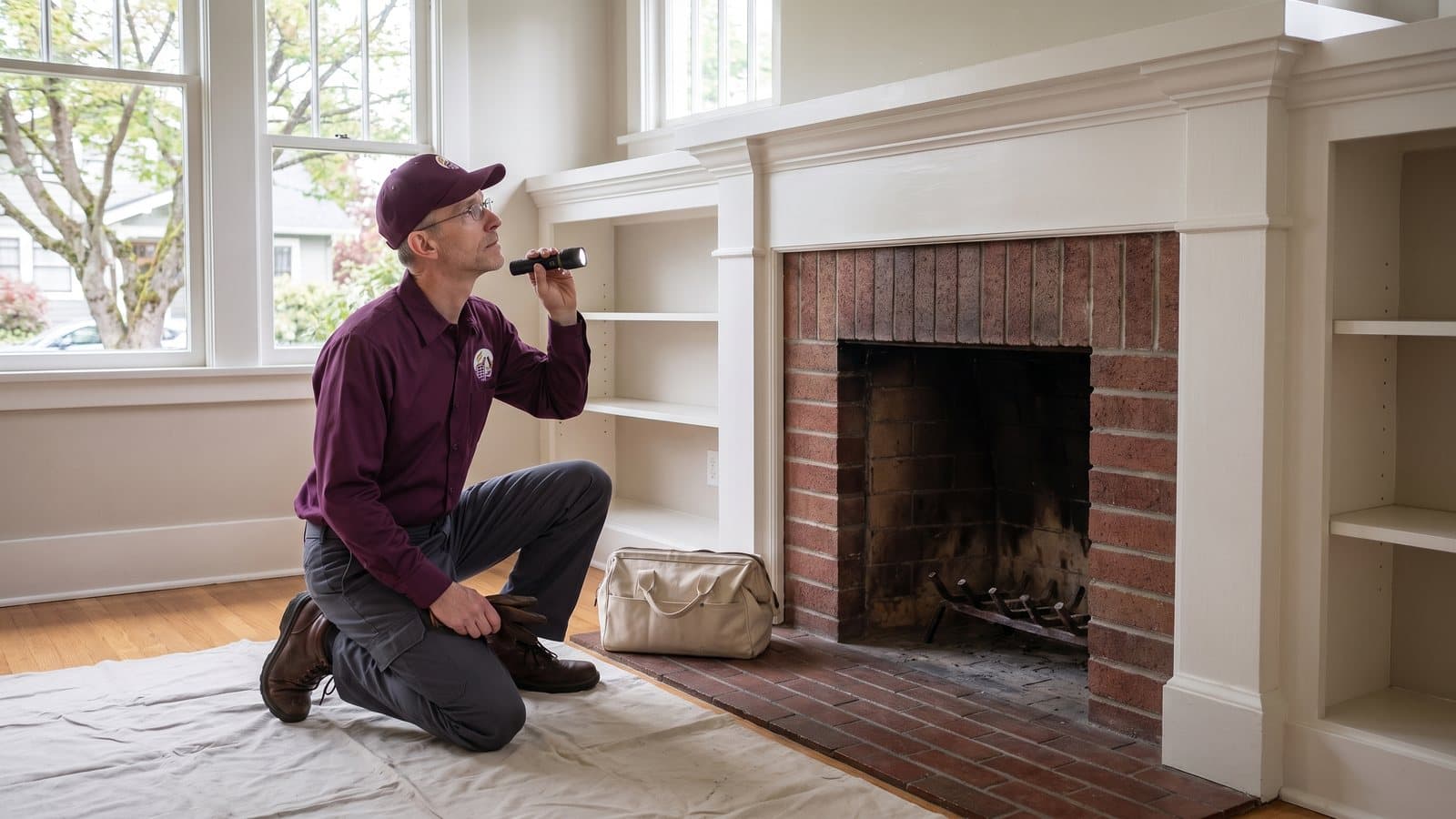
Which job your flue needs is settled by looking. Every chimney's inspection is $99 plus tax, and approving the quote deducts it from the sweep or the removal.
Frequently asked questions
How do I tell a certified wood stove from an uncertified one?
The Clean Air Agency offers a rule of thumb: an EPA label and a single glass door point to a certified unit, while two solid metal doors, or two glass doors, usually mean it is not. The difference matters during a Stage 1 ban, when only certified devices may burn.
Does a very hot fire burn the creosote out of a flue?
No. A deliberately hot fire in a coated flue is how chimney fires begin. Burn dry wood with enough air each time so that less is deposited, and have what does collect measured and removed.
Is a manufactured log cleaner than firewood?
It is one of the two legal fuels under the agency's rules, alongside seasoned firewood. Follow the directions on the wrapper, since many are meant to burn one at a time. No log, whatever its label promises, takes the place of having the deposit measured once a year.
How often should a North Seattle fireplace be swept?
By depth, not by date. CSIA's mark is 1/8 inch of soot in a masonry fireplace, or any glaze. NFPA 211, as CSIA cites it, calls for a check every year, and that check is when the depth is measured. Some years the answer is a sweep and some years it is not.
Sources
- CSIA: homeowner resources — accessed October 4, 2026
- PSCAA: legal overview of wood burning — accessed October 4, 2026
- PSCAA: about air quality burn bans — accessed October 4, 2026
- PSCAA: burn ban FAQs — accessed October 4, 2026
- PSCAA: 2024 data summary — accessed October 4, 2026
- WAC 173-433-120 (Cornell LII) — accessed October 4, 2026
- WAC 173-433-150 (Cornell LII) — accessed October 4, 2026
- ACS heating fuel by ZIP area — accessed October 4, 2026
- City of Seattle windstorm hazard profile — accessed October 4, 2026
- Washington State Fire Marshal notice — accessed October 4, 2026
- The Mad Hatter Chimney Sweep: 2025 guide — accessed October 4, 2026
- Housecall Pro: chimney cleaning article — accessed October 4, 2026
Related services