An uncapped flue is a pipe open to the sky, and during the wet half of Seattle's year the sky delivers something on better than one day in three. A cap is among the least expensive parts of a chimney and it shelters the expensive ones: the liner, the damper, the smoke chamber and the firebox. This guide goes through the four jobs a cap does here, what Seattle's code says about the mesh, how long each metal lasts, and what one runs installed.
Rain straight down an uncapped flue
WeatherSpark's climate record for Seattle counts 16.7 wet days in an average November, with about 7.5 inches of rain for the month. The long University of Washington record, kept from 1909 to 1983 a short way south of Ravenna, shows a yearly average of 34.11 inches spread over about 146 days. With no cap, a share of each of those days falls into the flue.
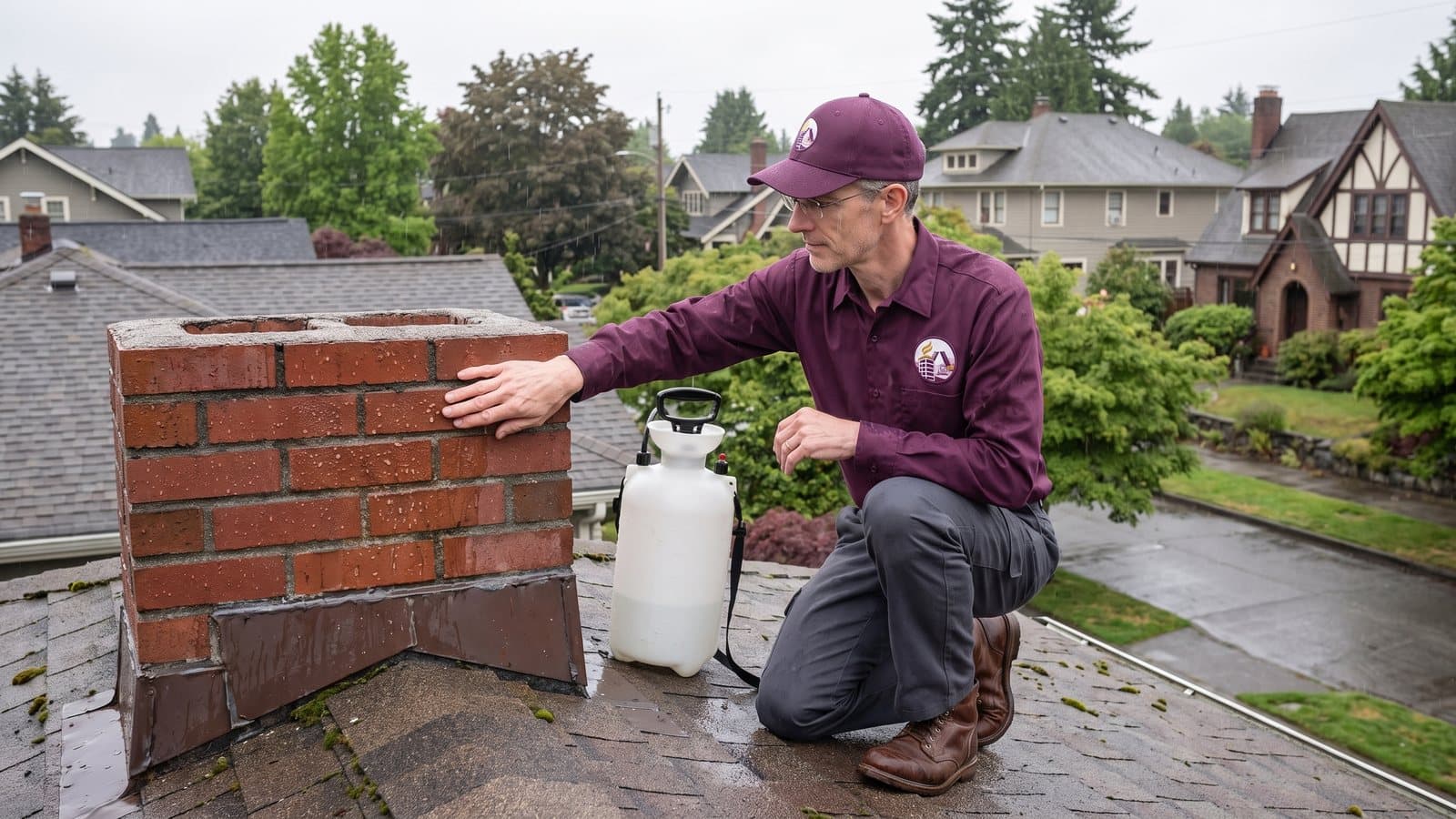
Inside, the water soaks the mortar joints between flue tiles, rusts the damper and the firebox hardware, and turns soot into an acidic paste that smells in damp weather. None of it shows from outside until a stain appears.
Wind over Phinney Ridge and the Maple Leaf hilltop
Seattle's windier season lasts about 6.3 months, October 15 to April 24, by WeatherSpark's reckoning. The city's emergency management office adds that terrain shapes wind, which accelerates over hills and ridges. Phinney Ridge and the hilltop of Maple Leaf, which reaches 466 feet at 92nd Street and Roosevelt Way, are North Seattle's high ground.
A cap with a solid lid keeps a gust from driving rain into the flue. In the major storms that office describes, with gusts up to 90 mph, an old cap held by one corroded band is also the first piece to leave the roof. Fastening is part of the job.
Leaves, needles and nests in the flue top
The city blames falling trees and limbs for much windstorm damage, and what comes down in smaller pieces lands on roofs. In Wedgwood, 35th Avenue NE is lined from NE 85th Street northward with flame ash trees planted between 1970 and 1972, in the city's first arterial street-tree program. An open flue near mature trees collects leaves and needles that hold moisture and can block the draft.
Animals find open flues too. Birds, squirrels and raccoons treat an uncapped chimney as shelter, and a nest above the damper is a blockage and a fire hazard at once. The mesh sides of a cap close that entrance.
Sparks, and the cap mesh Seattle's code specifies
The mesh has a second job: stopping embers. Where a spark arrestor is fitted, section R1003.9.2 of the Seattle Residential Code sets its openings. A 1/2-inch sphere has to be stopped and a 3/8-inch one let through, while the arrestor's net free area may not be smaller than four flue outlets put together. Finer mesh clogs with soot; coarser mesh lets embers out.
The same chapter fixes the height of the stack itself: where the chimney exits the roof, its top must clear that point by 3 feet at the least, and it must also rise 2 feet higher than whatever part of the house lies inside a 10-foot radius. A cap does not correct a chimney that is too short, and we note the height during the inspection.
The State Fire Marshal's heating-safety notice of September 2026 names a chimney cap in its short list of recommendations, next to a fireplace screen and working alarms. Dry summers raise the stakes: on August 1, 2026 the Governor's wildfire emergency declaration covered the whole state and brought a burn ban that stayed in force to September 30.
Which cap metal, and how long each one lasts
The service lives in the table come from the cap page of The Mad Hatter Chimney Sweep, which works in Seattle. They are one publisher's figures, not laboratory results.
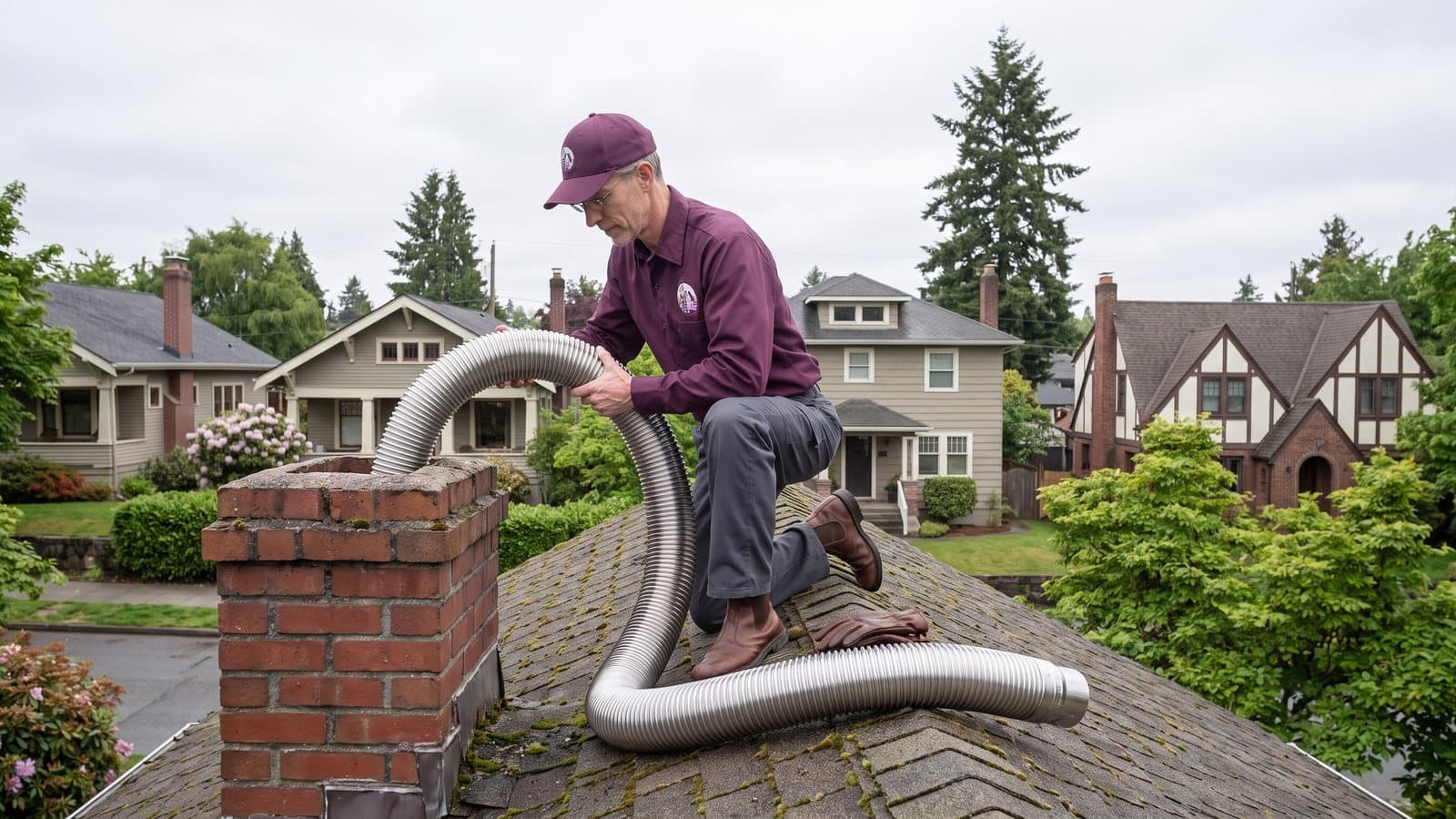
Shape matters as well. A single-flue cap clamps to one flue tile. A multi-flue cap is fastened to the crown and spans the entire stack top, crown included. A top-mount damper is a cap and a seal in one piece, closing the flue from above.
| Cap material | Published service life | Note |
|---|---|---|
| Galvanized steel | 5 to 10 years | Shortest life of the three |
| Stainless steel | 15 to 20 years or more | What we install as standard |
| Copper | 30 years or more | Zinc sulfate moss treatments attack it (OSU Extension) |
On Ballard Avenue, ask before changing the roofline
One local rule concerns a small area. Inside the Ballard Avenue Landmark District, any change to a building's exterior requires the district board to issue a Certificate of Approval before any work starts. If your building stands in the district and the cap would be visible, raise it with the board first. We found no published district guidance specific to chimney caps, so we do not guess at the answer.
Installed cap figures, ours and the published ones
A stainless cap installed by us runs $265 to $850. A stock cap on a single flue that is easy to reach is the low figure, and the high figure is a cap made to order or one spanning several flues.
Other published Seattle figures, read on October 4, 2026: The Mad Hatter Chimney Sweep lists $200 to $350 for one standard cap on a single flue and $400 to $800 for a multi-flue one, and Emerald City Chimney lists a standard stainless cap at $199.95 plus tax, installed. Fixr's national guide gives $300 to $600. Not our quote.
A cap is usually fitted on a visit that begins with the inspection: $99 plus tax per chimney, credited against the cap once you approve the quote.
Frequently asked questions
My chimney has never had a cap. Is the damage already done?
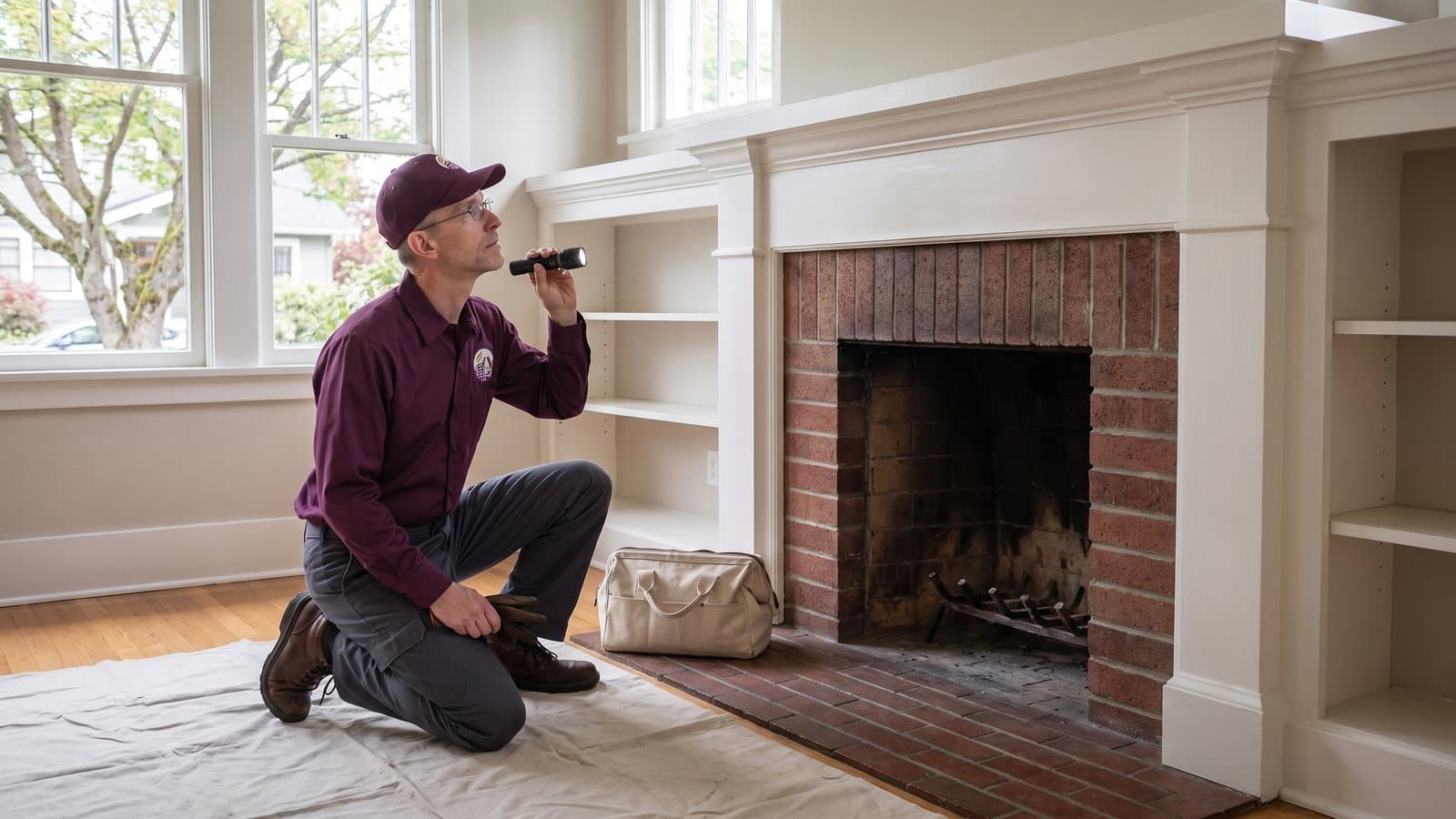
Not necessarily. It depends on how the flue was built and how much water it has taken in. The inspection looks at the tiles, the joints and the damper for the signs: eroded mortar, rust, staining. If they are sound, a cap is all you need. If they are not, you will know what to repair before the top is closed.
Does the vent of a gas fireplace take an ordinary chimney cap?
A gas unit has a termination of its own, specified by its manufacturer, and it should not be swapped for a generic cap. Where a gas insert vents through a liner inside a masonry chimney, the liner comes with a matching top plate and cap. We check which arrangement you have before quoting.
Can a cap make the fireplace draw badly?
One that is too small, set too low over the flue or clogged with soot can restrict the draft. That is the reason the code ties an arrestor's open area to the flue, at four times the outlet. A cap sized to the flue and kept clean does not hold smoke back.
What are the signs that an old cap should be replaced?
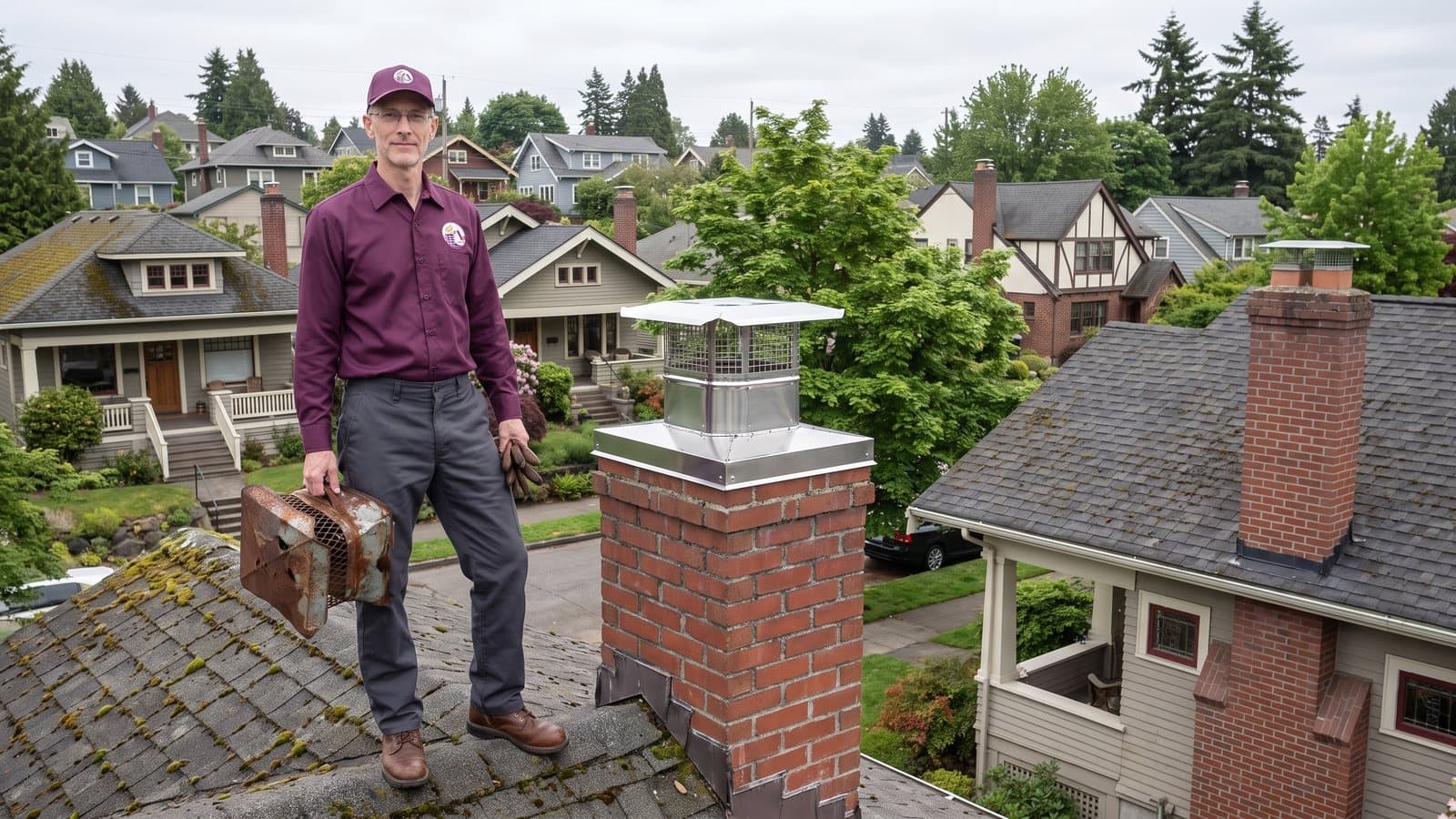
From the ground, with binoculars, look for streaks of rust running down the brick or the crown, a lid sitting crooked, torn mesh or a missing band. Rust flakes in the firebox are another sign. Galvanized caps are the usual candidates, given the 5 to 10 years one Seattle company allows them.
Sources
- WeatherSpark: Seattle weather by month — accessed October 4, 2026
- WRCC: Seattle UW station, 1909-1983 — accessed October 4, 2026
- Seattle OEM: windstorm hazard page — accessed October 4, 2026
- Wikipedia: Maple Leaf, Seattle — accessed October 4, 2026
- Wedgwood in Seattle History — accessed October 4, 2026
- UpCodes: SRC 2021 chimneys chapter — accessed October 4, 2026
- State Fire Marshal: fireplace safety — accessed October 4, 2026
- Governor's office: August 2026 burn ban — accessed October 4, 2026
- The Mad Hatter Chimney Sweep: cap page — accessed October 4, 2026
- OSU Extension: roof moss control — accessed October 4, 2026
- Seattle: Ballard Avenue Landmark District — accessed October 4, 2026
- Emerald City Chimney: posted rates — accessed October 4, 2026
- Fixr: chimney cap replacement guide — accessed October 4, 2026
Related services