Chimney safety
Old brick, long wet winters, ground that moves and an air agency that decides when wood may burn. This guide takes those four in turn for ten Seattle neighborhoods, and names the public source behind each figure.
The first is a request. In its heating notice of September 21, 2026, the State Fire Marshal's Office asked Washington residents to call in a professional once a year so that chimneys and fireplaces are inspected and cleaned. The notice counts six deaths across the state from home heating sources during the year before.
The second is the age of the houses. The 2020-2024 American Community Survey dates 89,841 of Seattle's 393,918 housing units, 22.8%, to 1939 or earlier. In ZIP area 98103, which Fremont has in common with Wallingford, Green Lake, Phinney Ridge and south Greenwood, the share is 34.7%. In 98115, spanning Ravenna, Wedgwood and Maple Leaf, nearly half of all homes (48.7%) predate 1960. The survey counts houses, not chimneys, so what stands on each roof is something only a visit can establish.
Every twelve months
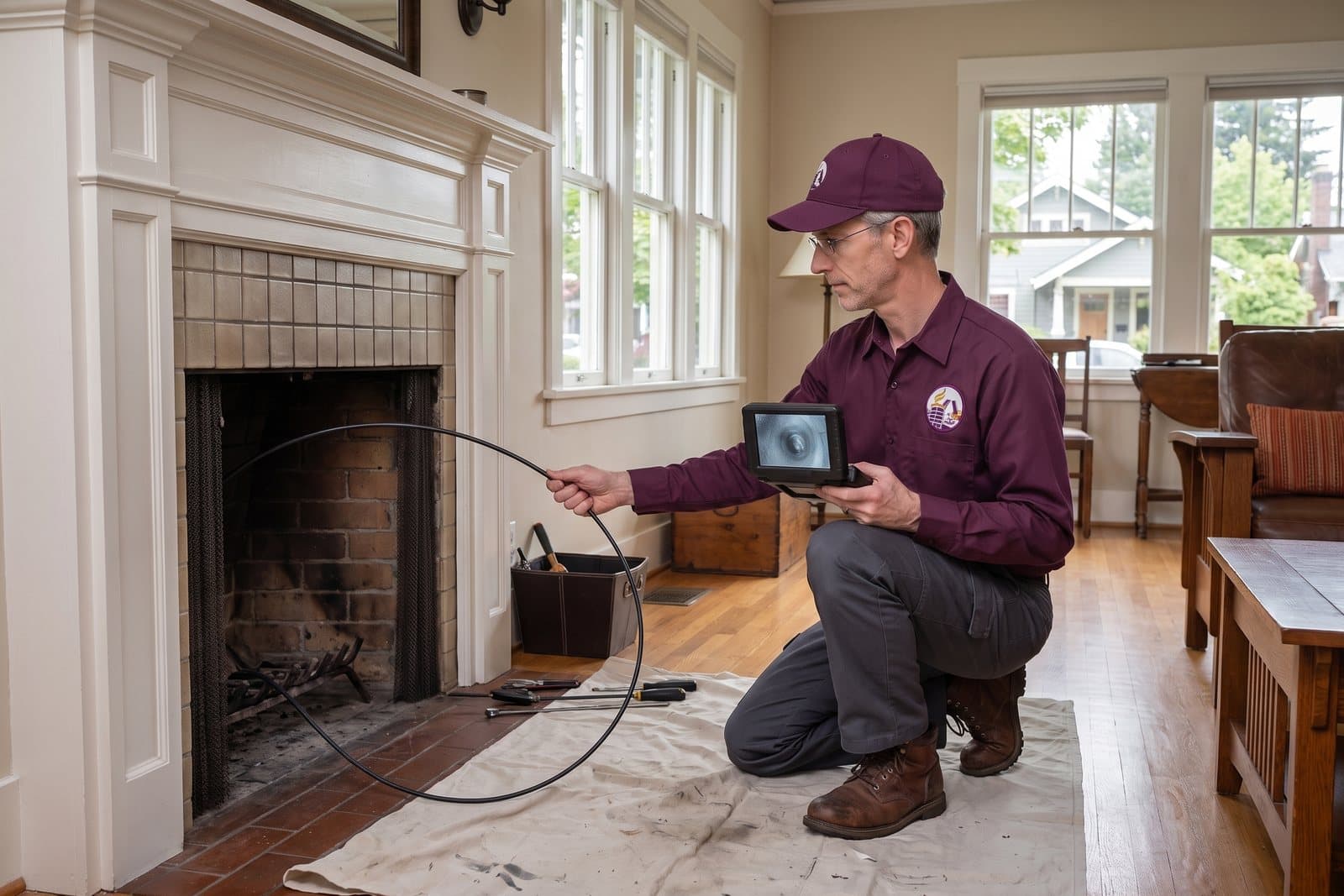
NFPA 211 is the national chimney standard. It is a purchased document, so this guide relies on the Chimney Safety Institute of America, which cites it for checking each chimney, fireplace and vent once a year, however little the system is used.
A chimney inspection works through those questions at the hearth and again on the roof. Summer is the easy season for it: WeatherSpark gives Seattle a clearer period of about 3.8 months, ending near October 8.
What a chimney fire feeds on
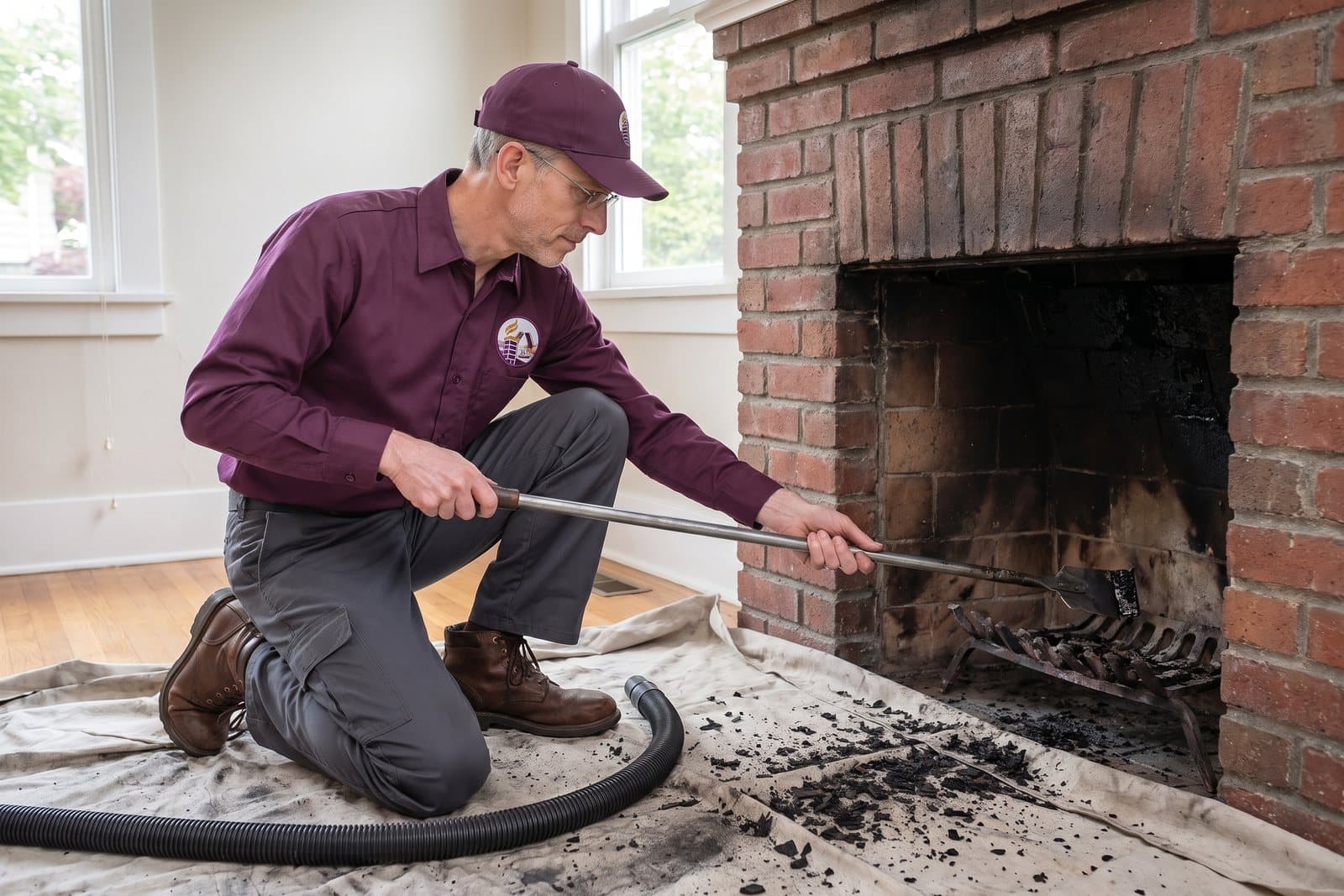
Wood smoke condenses on a flue as creosote, and creosote is fuel. CSIA sets the bar for a masonry fireplace at 1/8 inch of soot, lower if any glaze has formed, and for a factory-built fireplace at any appreciable buildup. A chimney sweep deals with soot and crust. Glaze is the business of creosote removal.
Fuel choice is regulated as well. The Clean Air Agency and WAC 173-433-120 allow seasoned dry firewood and manufactured logs. Garbage, treated wood and plastics are prohibited, and paper is limited to what it takes to start the fire.
Air quality
For Seattle, the body that calls an air quality burn ban is the Puget Sound Clean Air Agency. Four counties fall under it (King, Snohomish, Pierce and Kitsap), so one declaration covers Ballard and Maple Leaf on the same day. The agency acts on a forecast: fine particles expected to pass 35 micrograms per cubic meter, as a 24-hour average, sometime in the following 48 hours.
One exception exists, for the home with no adequate heat other than its wood device, and the exemption has to be applied for and approved before a ban. The agency's test for adequate is a system able to hold 70°F at three feet above the floor; a furnace that is expensive to run does not qualify a household. Under WAC 173-433-150, smoke still visible three hours after a ban is declared counts as prima facie evidence of a violation, and anyone already burning must stop adding fuel.
Two rules apply with no ban at all. Chimney smoke is held to 20% opacity, with six back-to-back minutes in a single hour as the measure. And smoke that affects neighbors is a nuisance the agency can enforce under its Regulation I, Section 9.11. Burn bans called by the fire marshal for fire safety are a different tool. Current air quality status is posted on the agency's website; the phone line is 800-595-4341.
Anything that burns produces it: wood, pellets, gas, charcoal. A sound flue or vent takes it outdoors, and an alarm on every floor tells you when that has stopped working.
How North Seattle heats
Citywide, the American Community Survey finds electricity as the main heat in 61.1% of occupied homes and utility gas in 32.8%. About 10,600 homes, 2.9%, still burn fuel oil, and 727 households name wood. The survey records one primary fuel per home and has no count of fireplaces, so it understates how many living rooms have one. The failure points do not depend on the fuel: a vent section that has separated, an uncapped outlet with a nest in it, a liner sized for an appliance that was replaced years ago. Seattle's windstorm profile adds a warning from past outages: people have died after burning charcoal indoors to keep warm. If a carbon monoxide alarm sounds, leave the house before you do anything else.
Rain first, frost second
The Western Regional Climate Center places the lowlands north to Seattle at 32 to 35 inches of precipitation a year, close to the eastern edge of the Olympics' rain shadow. The Sand Point record adds how that rain arrives: some 158 days per year with measurable precipitation, of which only about 4 reach an inch.
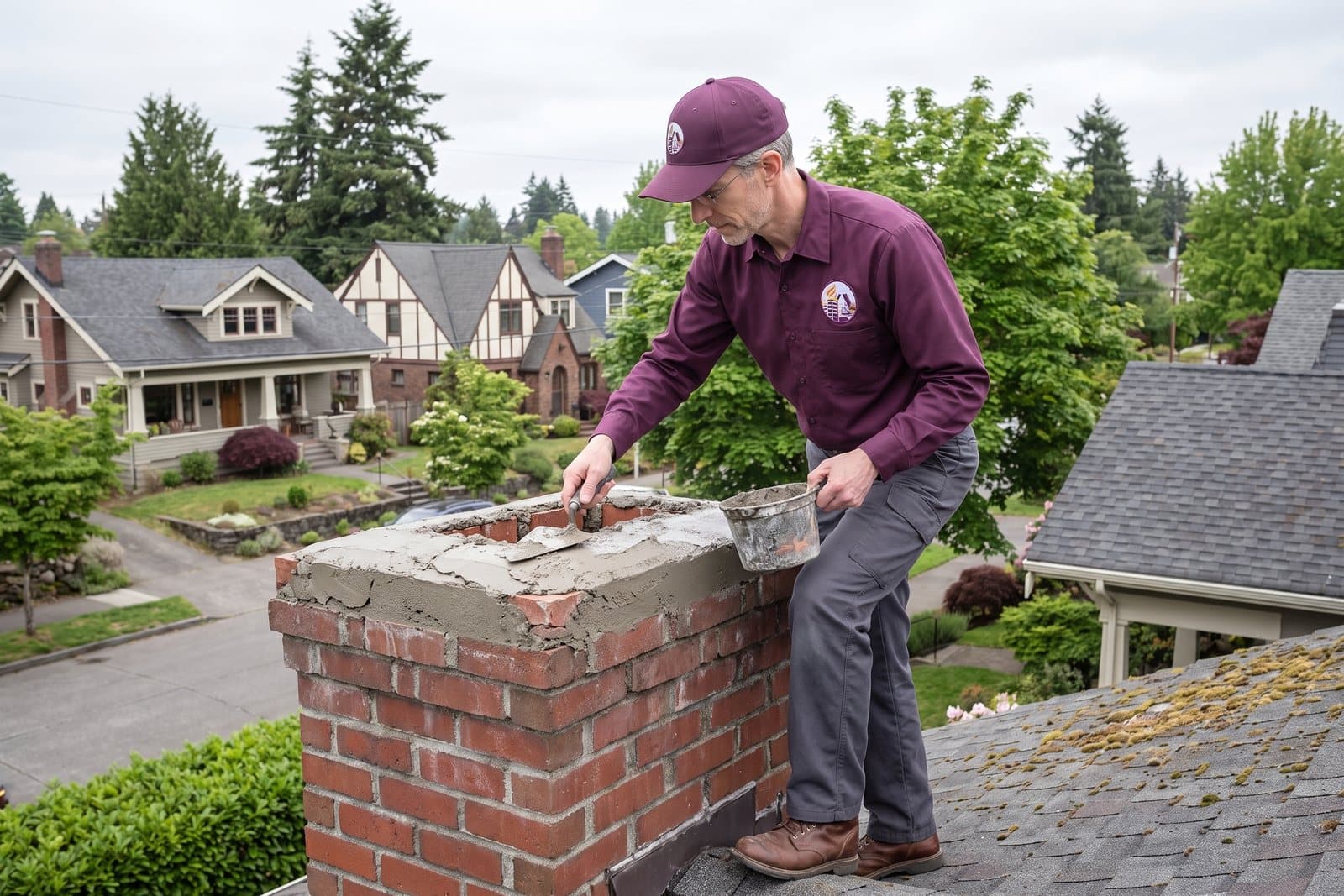
Brick that seldom dries is brick that is wet when a freezing night comes. Masonry repair closes the crown and the joints once they have opened, and waterproofing keeps sound masonry from taking on the next storm.
All ten neighborhoods
WeatherSpark's modelled year gives November about 7.5 inches of rain across 16.7 wet days, against 0.7 inch in July. Its cool season spans November 12 to March 1, and it rarely shows a reading under 28°F.
Ravenna, Wedgwood, Maple Leaf, Northgate
At this National Weather Service site in northeast Seattle, 35.50 inches fell in an average year from 1986 to 2016. Lows of 32°F or colder came on 24.0 days annually, and yearly snowfall averaged only 3.6 inches.
Ravenna, Wallingford
A record that runs from 1909 to 1983, kept just south of Ravenna: 34.11 inches annually on roughly 146 days, 33.1 freezing nights each year, 11.0 of them in January, and a low of 5°F on December 12, 1919.
Wallingford, Fremont
Beside Lake Union, the 1972-1998 record shows 37.92 inches per year over some 151 days. Nights at freezing or under numbered about 24.4 annually, and the coldest, 11°F, came on February 4, 1989.
The three stations sit on the south and east edges of the area. No station record was found for Ballard, Phinney Ridge or Greenwood, and no source counts freeze-thaw cycles for North Seattle, so this guide gives neither.
Earthquakes
Seattle's Department of Construction and Inspections puts the odds plainly: an 86 percent chance of a damaging earthquake within 50 years. The Office of Emergency Management expects a deep quake of magnitude 6.0 or greater about every 30 to 50 years, and lists 1949 and 1965 before the Nisqually earthquake, which struck on February 28, 2001 at magnitude 6.8 from a depth near 52 kilometers. It also describes the Seattle Fault, which crosses the middle of Seattle from east to west and could produce a quake as large as magnitude 7.5.
What does that mean for a chimney? FEMA's advisory on masonry chimneys, written after a 2014 California earthquake and used here for general behavior, singles out old unreinforced brick stacks, their mortar weakened by age, as the likeliest failures. It warns that modern code-compliant masonry chimneys can be badly damaged too. Its advice after damage is not to rebuild the same thing: cap the chimney at the roof if the fireplace is retired, or rebuild from the firebox top with a metal flue in a light-framed enclosure. Where nothing can be done yet, it suggests not sleeping next to the chimney.
For new masonry chimneys in Seattle's seismic design categories, the residential code requires four continuous No. 4 vertical bars for widths up to 40 inches and two steel straps tying the chimney into the framing. Seattle's retrofit program for unreinforced masonry is aimed at larger buildings, more than 1,100 of them, not at wood-frame houses with brick chimneys. No source we could read counts chimney damage by North Seattle neighborhood, so none is claimed here. After any quake you feel, a chimney repair assessment begins with the stack above the roof and a camera in the flue.
On the roof
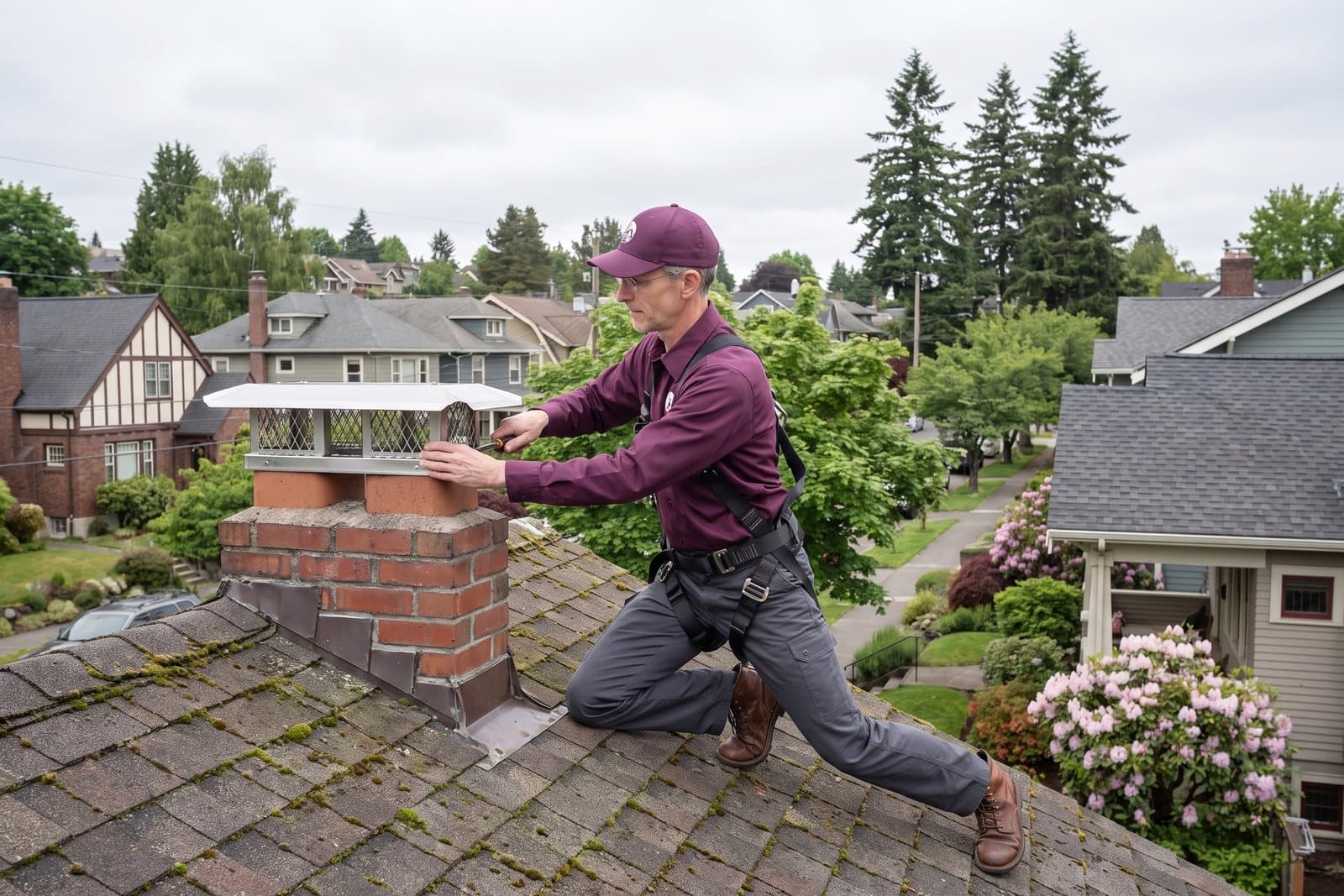
Each line above is a section of the 2021 Seattle Residential Code (R1003.9 through R1003.20). A chimney cap appears in the State Fire Marshal's recommendations, and flashing seals the line where stack and shingles meet.
Wind is the test. Seattle's hazard profile says the building code asks new structures to withstand a three-second gust of 85 mph, and that wind speeds up over hills and ridges. WeatherSpark dates the windier season from October 15 to April 24. Shade matters too. Roof moss, Oregon State University Extension points out, returns after cleaning unless more sun reaches the roof.
Around the firebox
Seattle's residential code measures the room side of a masonry fireplace. The hearth is at least 4 inches thick. Its extension runs 16 inches out from the opening and 8 inches beyond either side when the opening is under 6 square feet, and 20 and 12 inches when it is larger. Combustible framing keeps 2 inches from the front faces and sides and 4 inches from the back.
Seattle amends the fireplace section (R1001.7.1) with four additions. The damper must be ferrous metal and sit at least 8 inches above the opening. The flue damper must close tightly and have an easily reached control. Combustion air must come from outdoors through an opening of 6 square inches or more that has a damper of its own. And the fireplace needs tight glass or metal doors, or else a draft induction fan. The State Fire Marshal covers the rest of the room: a three-foot zone around the fireplace kept clear of children, and ashes cooled fully, then stored in a lidded metal container outdoors and away from the house.
A second exhaust
The U.S. Fire Administration studied clothes dryer fires in residential buildings for 2008 to 2010 and estimated 2,900 of them a year. The leading factor, in 34 percent of cases, was a failure to clean. Dust, fiber and lint were the first thing to ignite in 28 percent, and the fires were most frequent in January.
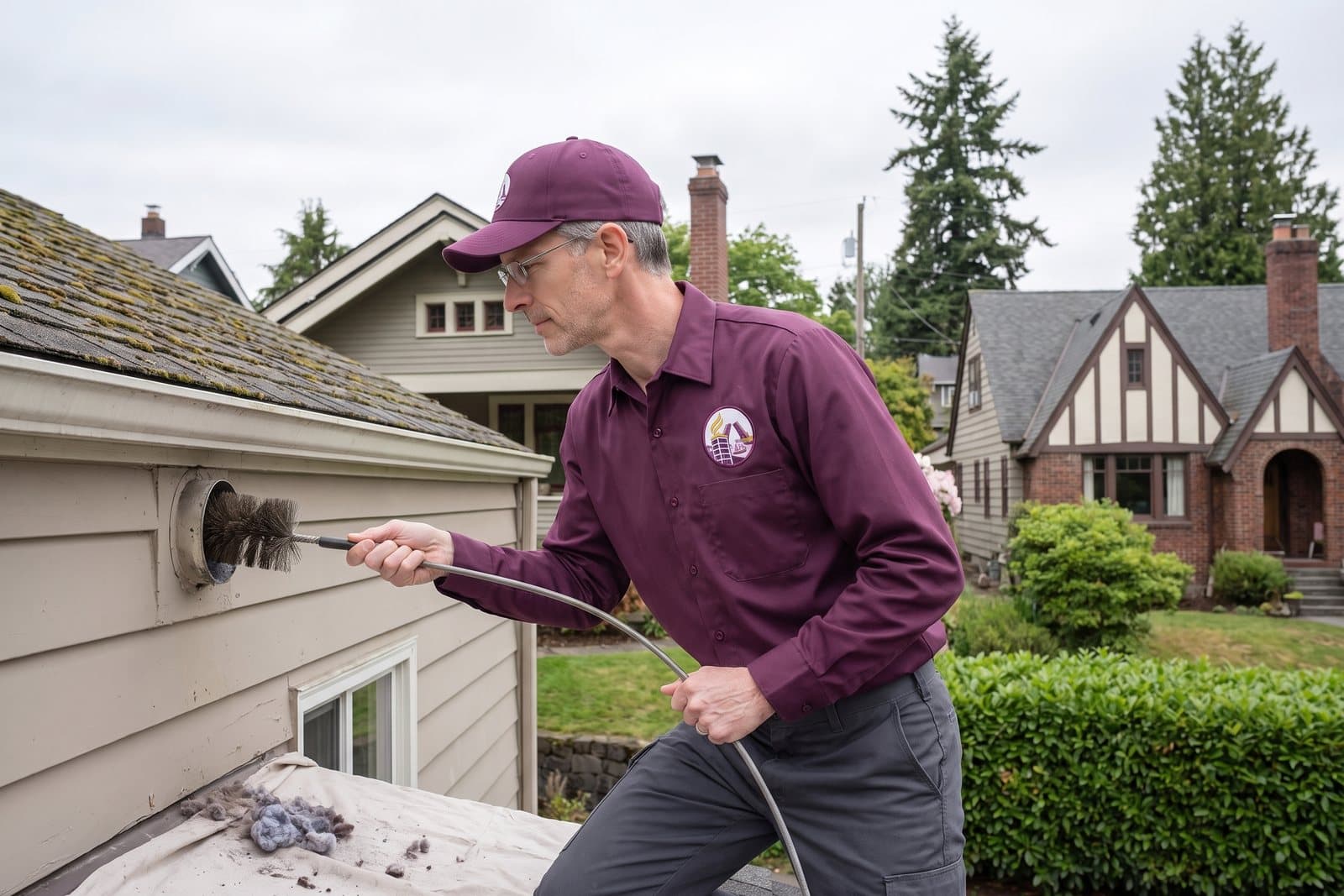
The bullets are warning signs, not code. Dryer vent cleaning empties the duct from the machine to the hood and reports the airflow at the end.
Smoke from elsewhere
The Clean Air Agency calls the period since 2015 one of unprecedented wildfire smoke for the region. Years vary. In 2024 it recorded no wildfire smoke impact, and the only notable particle spikes were fireworks on July 4 and 5. Then came 2026: the wildfire emergency the Governor declared on August 1 carried a statewide burn ban that held until September 30. Public Health – Seattle & King County scales its response by Air Quality Index, from early warnings at 101-150 to cancelled outdoor events at 201-300.
For smoky days the agency recommends a HEPA filter, or a box fan with a MERV-13 filter fixed to it, a designated clean room and closed fresh-air intakes. A fireplace is one more opening to the outside, which is a reason to confirm before August that the damper closes fully and the cap is intact. In winter the direction reverses: the agency's 2024 data summary names home-heating wood smoke as the region's main cold-season source of fine particles.
Permits
Every address in this guide is inside Seattle, so a single building authority covers them all: SDCI, Seattle's construction and inspections department. The cards below go no further than its pages and the code do.
Section R105.2 of the Seattle Residential Code exempts repointing a chimney, painting and cleaning, and minor repairs under a value ceiling counted over six months. A roof replacement that leaves the building envelope unchanged is exempt too. Exempt work must still meet the code, and the exemption never reaches load-bearing supports or anything that lowers fire resistance.
SDCI's guide says most projects past that short list need a permit and gives mechanical, gas, furnace and fireplace work as examples. Mechanical permits start in the Seattle Services Portal. SDCI quotes about 9 weeks for a standard review; for a simple job, the subject-to-field-inspection permit can come inside 24 hours. Gas lines fall outside the mechanical permit.
No SDCI page we could open says in so many words whether a new liner, an insert, a wood stove or a rebuild above the roof needs a permit. We do not guess in either direction. We ask SDCI before work starts and tell you the answer.
Inside the district, which Seattle Municipal Code chapter 25.16 governs, any change to the outside of a building needs a Certificate of Approval from the district board. The city's page is silent on chimney repointing and masonry cleaning, so the board is the place to ask.
Seattle enforces the 2021 Seattle Residential Code: the 2021 International Residential Code as amended by Washington and by Seattle. The state put its 2021 codes into force on March 15, 2024. SDCI does not expect to finish adopting the 2024 Seattle codes before May 2027.
Washington requires contractors to register with the Department of Labor & Industries and to carry a bond and liability insurance. L&I's verify tool shows a registration's status. SDCI adds that a Seattle business license may be needed even when a firm's office is outside Seattle.
Division of labor
Most of chimney safety is habit. A share of it belongs to whoever lights the fire, and a share needs a roof ladder, a flue camera or a gas meter.
Late summer
Seattle's wetter season begins on October 10 in WeatherSpark's figures. Earlier visits leave time for repairs in fair weather.
CSIA's mark for a masonry fireplace is 1/8 inch of soot, or glaze of any thickness. Under that, the brushes can wait.
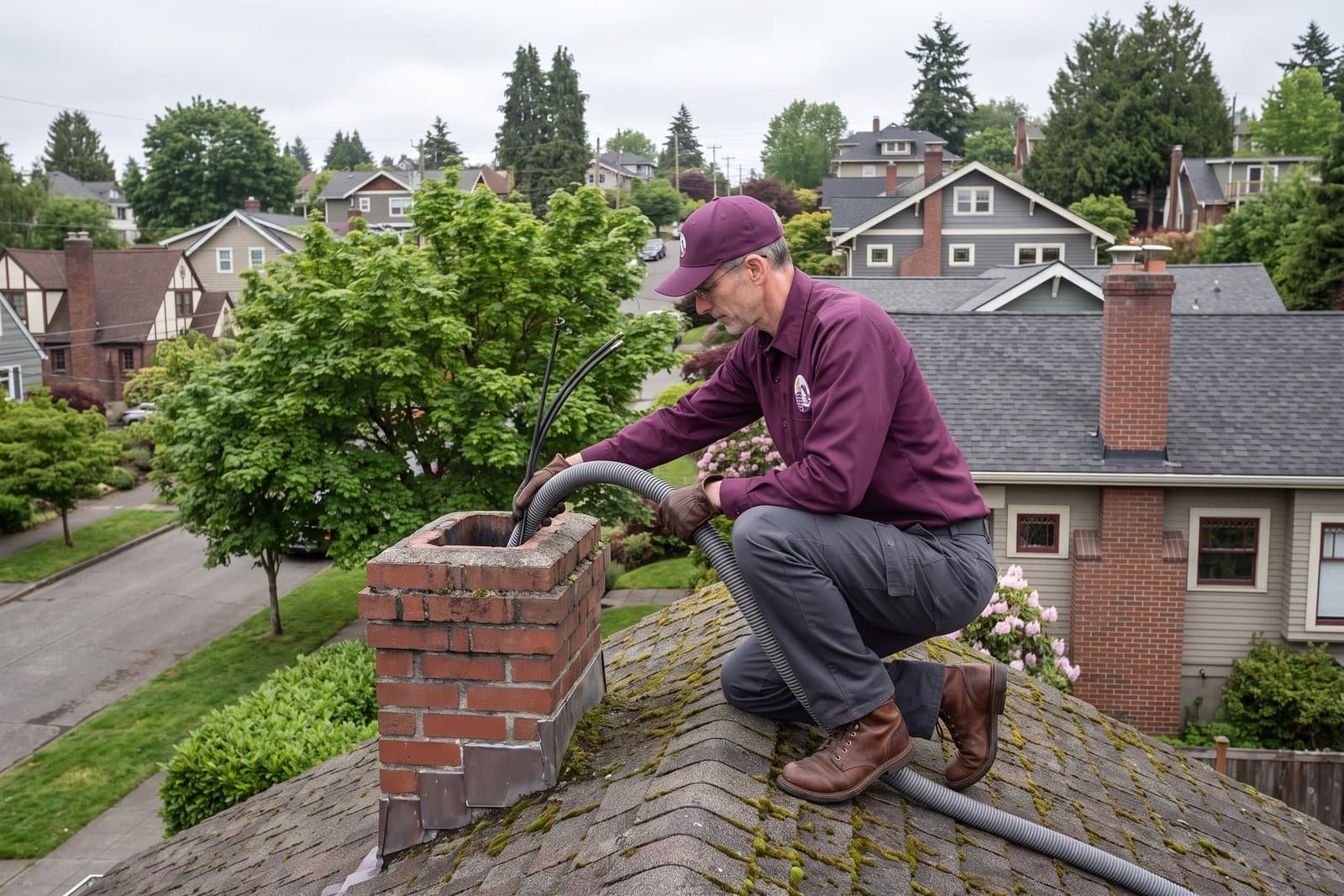
A cap that is missing or crooked, plants growing from the crown and dark streaks on the brick are all visible from below.
Seattle's windstorm profile blames falling trees and limbs for much storm damage, and more sunlight slows moss.
Dial 800-595-4341 for the Clean Air Agency's recording, or open its status page to see the current stage for King County.
Further reading
Each article takes a single question about North Seattle chimneys and answers it with the same kind of sourcing used on this page.
Questions
Sources
Every page listed was read on October 4, 2026. NFPA 211 is not published openly, so it is reported through CSIA. Seattle's residential code is read in the copy UpCodes hosts, and Census figures are for ZIP areas, which do not follow neighborhood lines.
North Seattle Chimney Pros sends a technician who examines the chimney from hearth and roof, photographs what is found and writes it up. You pay $99 plus tax; when our quote has your approval, the job is reduced by that amount.